Sportmax: a wheel shop where buying the wrong part is impossible
The Client
Sportmax sells premium European alloy wheels, spare-wheel kits and TPMS sensors across North Macedonia, from Skopje.
The Issue
Alloy wheels are not a normal e-commerce product. A wheel that is one millimeter out on center bore, or a few millimeters out on offset, physically will not fit the car — and the customer does not find out until it is unboxed and on the driveway. Every wrong order is a return, a refund, and a customer who does not come back.
Fitment is a compatibility problem wearing a retail problem's clothing. A customer who does not know their vehicle's PCD cannot safely browse a wheel catalog, so the two ways this normally goes are both bad: the shop hides the specification and absorbs the returns, or it publishes the specification and loses everyone who does not speak it. The store had to do neither — it had to make the compatibility decision on the customer's behalf, and then show its working.
The Solution
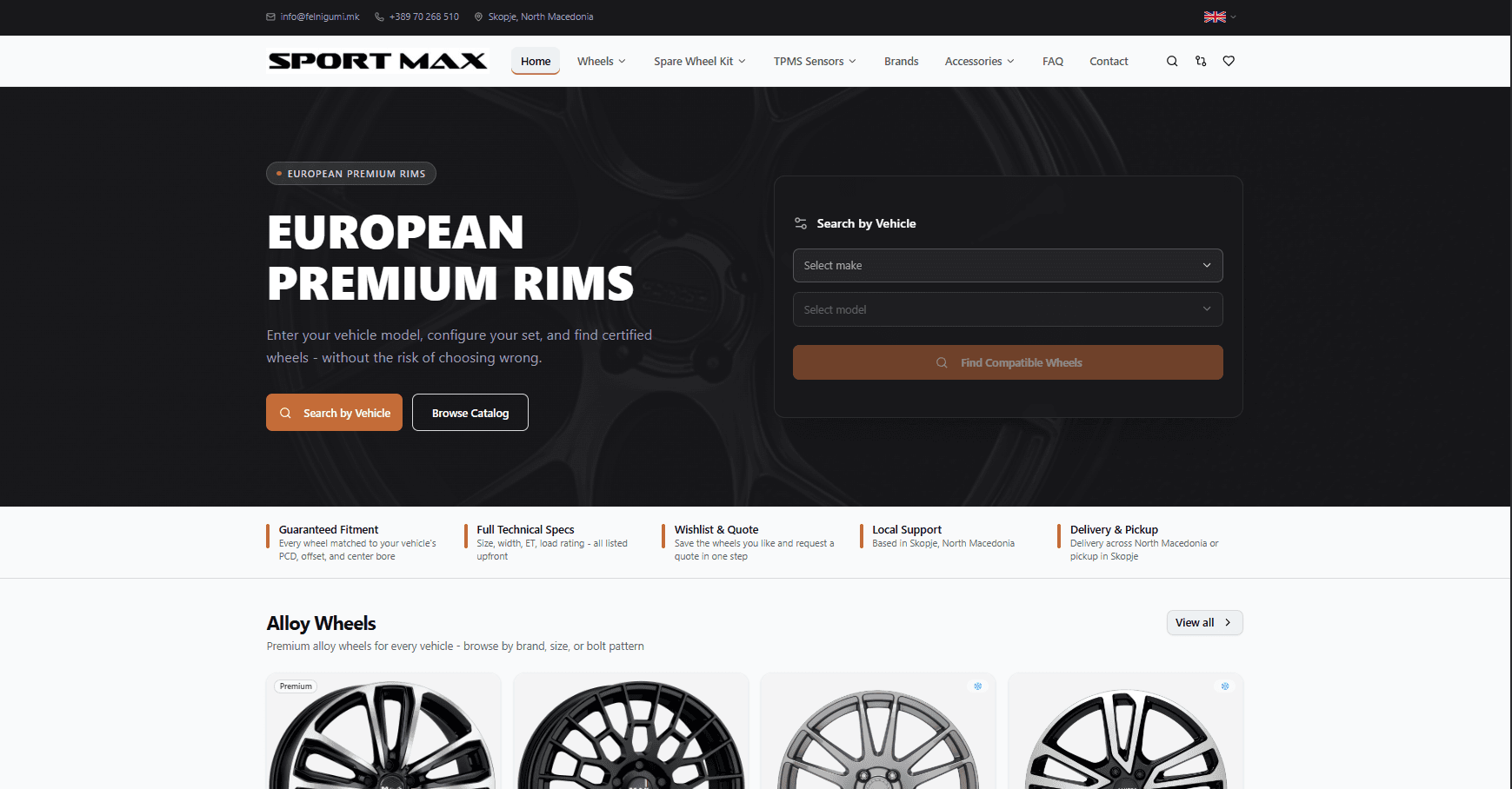
Search by vehicle, not by part
Make and model in, compatible wheels out. The fitment rules run before the catalog renders, so an incompatible wheel is never an option the customer has to rule out for themselves.
One dataset, three configurators
Wheels, spare-wheel kits and TPMS sensors are separate purchases with the same underlying compatibility question. They share one fitment model, so a change to the vehicle data is a change everywhere at once.
Specification published, not buried
Diameter, width, ET, PCD, center bore and load rating on every listing. A customer who does know what they are looking at can verify the match themselves — which is what turns a guess into a purchase.
Bilingual from the content model up
Macedonian and English are two renderings of one catalog rather than two catalogs, so nothing drifts out of sync when stock or pricing changes.
Results at a glance
Wrong-fitment orders designed out of the funnel rather than handled after the fact
Impact
Why This Matters
Most conversion work is about persuasion. This was about removing a category of mistake: when the wrong purchase is impossible, the customer does not need to be reassured, and the shop stops paying for returns that were never really the customer's error.
Ready to replicate these results?
Learn more how a similar system can handle your specific challenges.